
Most parents believe they have a good relationship with their children. Most children quietly disagree.
The gap rarely comes from bad intentions. It comes from postponed conversations, unspoken expectations, and the assumption that love alone is enough to keep the connection strong. Fathers especially fall into this pattern, showing up consistently in practical ways while staying silent on the things that matter most.
Building trust with children is not a single moment. It is a pattern of behavior, built slowly over years and broken just as slowly, often without either side noticing until the distance feels impossible to close.
Why Fathers Struggle with Building Trust with Children
Most fathers do not realize trust is eroding until a daughter stops talking to them.
She stops sharing the small things first. Then the big things. Then she stops coming to him at all, not out of anger, but out of habit. She learned, over time, that certain topics were off-limits, that vulnerability made things awkward, and that his advice came with conditions she did not always want to meet.
This is not a failure of love. It is a failure of communication.
Gregory Thomas Walker recognized this in his own relationship with his daughters, Gaelyn and Erryn. After 19 years of fatherhood, he admitted that despite his best intentions, too many important conversations had been pushed aside. The urgent always seemed to crowd out the meaningful. By the time his daughters were 19 and 15, he realized he had said more of what they did not need to hear and less of what they truly did.
For practical guidance on how to begin these conversations before the window closes, read our blog on How to Have Effective Communication with Kids About Sensitive Topics.
What Building Trust with Children Actually Requires
Trust between a parent and child is not built through rules. It is built through consistency, honesty, and the willingness to show up for the conversations that feel uncomfortable.
Children, especially daughters, are paying close attention to whether their fathers mean what they say, follow through on what they promise, and show up when things get hard. They notice whether a father’s words and actions match. They remember when they do not.
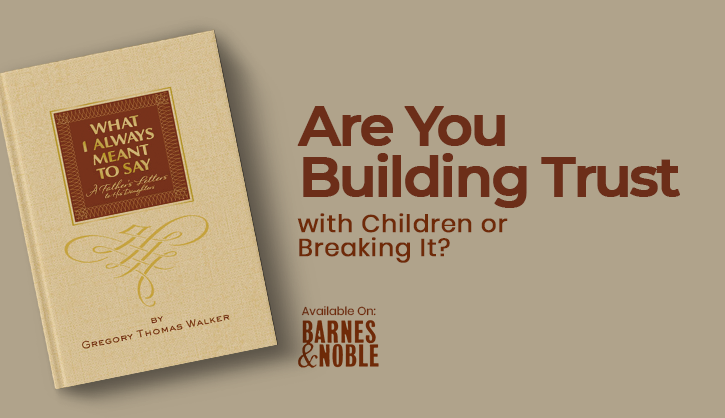
Gregory’s approach in What I Always Meant to Say offers a framework that any father can follow. He wrote honest letters to his daughters covering the topics most parents avoid: faith, money, identity, relationships, forgiveness, and unconditional love. Not because he had perfect answers, but because he understood that saying something imperfectly is always better than saying nothing at all.
5 Ways Fathers Break Trust Without Realizing It
Understanding where trust breaks down is the first step toward rebuilding it.
1. Staying Silent on the Topics That Matter Most
When a father avoids talking about money, relationships, faith, or identity, his daughter does not assume the topics are unimportant. She assumes she cannot bring them to him.
Silence communicates more than most fathers realize. It tells a daughter that certain parts of her life are not safe to share. Over time, she stops trying. Improving parent-child relationships starts with recognizing which conversations have been missing and having the courage to start them, even late.
Gregory spent years observing this pattern in his own fatherhood before acting on it. His solution was not a single sit-down talk. It was a series of honest, written letters that covered every topic he had meant to address. Each one was an act of trust-building, not through grand gestures, but through the simple discipline of finally saying what needed to be said.
2. Correcting Without Connecting
Many fathers lead with correction. A daughter makes a mistake, and the response is immediate: what went wrong, what she should have done, what needs to change.
Correction without connection creates defensiveness, not growth. A daughter who feels constantly evaluated will stop bringing her problems to her father. She will solve things alone, sometimes badly, rather than risk another lecture.
Guiding children with love and respect means leading with curiosity before correction. Ask what happened before explaining what should have happened. Understanding her perspective before offering yours is not a weakness. It is the foundation of a relationship where she actually listens.
3. Making Love Feel Conditional
Children should never have to wonder whether they are loved. But many do not, not because their fathers do not love them, but because that love was never made explicit.
Gregory’s very first letter in What I Always Meant to Say addresses this directly. He writes that his love for his daughters is unconditional, irrevocable, and everlasting, and that regardless of what they do, where they go, or who they choose to become, that love will never change.
That kind of explicit reassurance is not automatic. It has to be said, clearly and repeatedly. A daughter who knows her father’s love is not tied to her performance, her choices, or her success is a daughter who feels safe enough to be honest with him.
4. Being Consistent in Rules but Inconsistent in Presence
Fathers often hold the line on rules while showing up unevenly in relationships. The expectations are clear. The emotional availability is not.
A daughter learns to respect rules she understands and trust a father she knows. When rules exist without relationship, they breed resentment rather than responsibility. Creating an open dialogue with children requires more than enforcing structure. It requires being present enough that a daughter actually wants to come to her father with her real questions and real struggles.
5. Waiting for the Right Moment That Never Arrives
This is perhaps the most common way trust erodes. A father tells himself he will have that conversation when she is older, when things calm down, when the timing is better.
The timing is never perfect. And daughters do not wait. They grow up, form their own conclusions, and find other people to fill the guidance gap their fathers left open. Talking to children about difficult issues before they become crises is always more effective than trying to rebuild after the damage is already established.
Gregory waited longer than he intended before writing his letters. He was honest about that. But he also chose to act before it was too late, and the result was a book that gave his daughters the guidance they needed and gave him the relationship he had always meant to build.
For more on how Gregory’s approach to responsibility and trust shaped his daughters, read our blog on Parent-Child Relationship Help: Building Trust and Respect.
How This Book Helps Fathers Start Rebuilding
What I Always Meant to Say is not a parenting manual. It is a father’s honest attempt to say everything he had been carrying for years.
For fathers who recognize themselves in any of the patterns above, this book offers two things. First, it models what honest, loving communication with a daughter actually looks like. Second, it gives daughters the words their fathers may still be struggling to say out loud.
Reading it together can open conversations that have been closed for years. Reading it alone can help a father identify exactly where he needs to show up differently.
The book is available at Barnes and Noble and through the author’s official website shop. It is also available as an audiobook for fathers and daughters who prefer to experience it together.
Final Thoughts
Building trust with children is not complicated. But it is consistent work.
It requires showing up for the uncomfortable conversations, making love explicit rather than assumed, and choosing presence over postponement. Daughters do not need perfect fathers. They need the present ones.
Gregory Thomas Walker’s letters are proof that it is never too late to say what you always meant to say. And for most fathers, the first step is simply deciding to start.
FAQs
Q1: What does building trust with children actually look like day to day?
It looks like consistent honesty, following through on what you say, showing up for hard conversations, and making love explicit rather than assumed. Small, repeated acts of reliability build more trust than any single grand gesture.
Q2: How does staying silent break trust with a daughter?
When a father avoids important topics, his daughter learns those subjects are off-limits. Over time she stops bringing her real questions and struggles to him and finds other sources for guidance, not always reliable ones.
Q3: Is it too late to rebuild trust if the relationship is already distant?
It is rarely too late. Gregory Walker began writing his letters after years of missed conversations and still managed to say everything that mattered. Rebuilding starts with one honest conversation, not a perfect one.
Q4: How does Gregory Walker’s book help with improving parent-child relationships?
It models honest, loving communication across the topics most fathers avoid. Reading it gives fathers language for what they feel but struggle to express, and gives daughters insight into what their fathers may be carrying silently.
Q5: Where can I find this book?
What I Always Meant to Say is available at Barnes and Noble and through authorgregorytwalker.com.